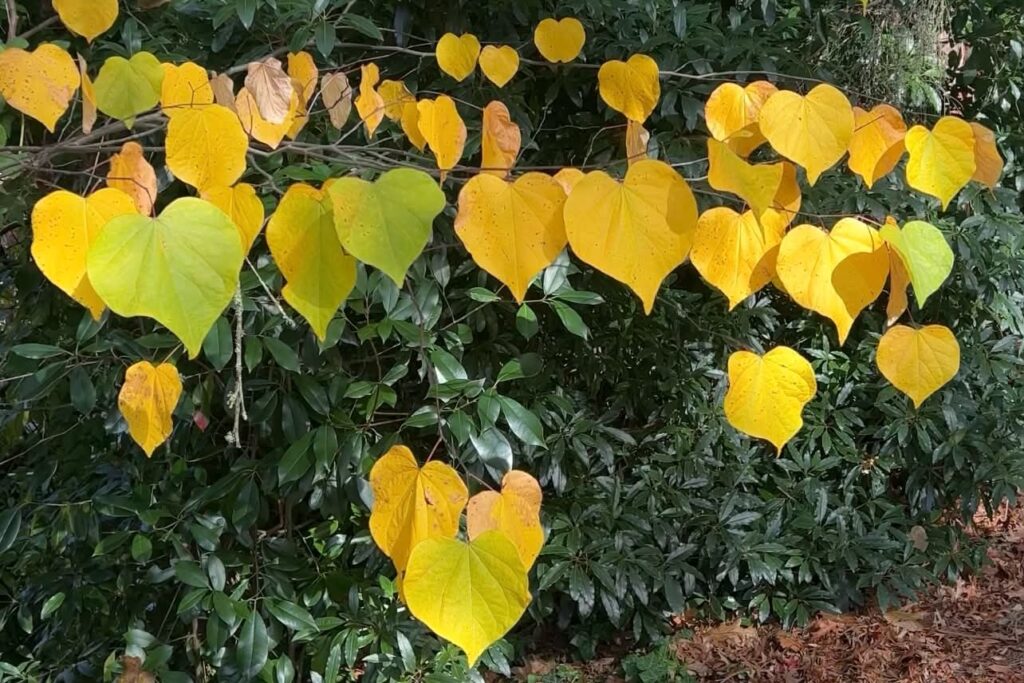
“Stop the car!” I squealed when an unexpected explosion of golden foliage leapt into my field of view. Late for an appointment and driving down an unfamiliar side street, I threw open the passenger door and scurried toward the beauty that beckoned me.
A large branch cantilevered over a timber fence, covered in palm-sized, translucent golden leaves, each one larger than my outstretched hand and shaped like a heart, welcomed me in. I’ve never been so grateful for a wrong turn.
Beauty in its many forms is the reward for paying attention. But it isn’t only that. It’s also what draws our attention in the first place, the thing that reaches out and asks to be noticed before we’ve done anything to earn it. These two ideas might sound like a contradiction. They aren’t. They’re really the same motion, just viewed from opposite ends. It’s also the only explanation for why beauty can ambush someone who wasn’t looking for it at all, the way it ambushed me on that side street, appointment forgotten, engine still running.
The Made Object
There’s a Japanese practice called kintsugi, where a broken bowl isn’t discarded or hidden. The cracks are filled with gold instead, so the break becomes the most visible part of the object rather than the part everyone politely pretends isn’t there.
A perfect bowl and a mended one can hold the same tea. Only one of them tells you anything. The perfect bowl asks nothing of you. The mended one has a history you can trace with your eyes, evidence of a hand that decided the damage was worth honouring rather than erasing. This is, I think, the real difference between something merely well-made and something beautiful: the object that carries a story inside its craftsmanship asks more of your attention, and gives you more back for having offered it.
The Unmade World
Beauty in nature has never once asked to be witnessed. A forest that has spent a thousand years perfecting the exact angle its canopy lets light through was never performing for an audience. It simply is, and has always been, whether or not a single person ever walks beneath it.
The same is true of people. A stranger’s unguarded kindness, the particular way someone moves through a room, an old woman’s hands as she works, unbothered by anyone watching. None of it is trying to be seen. It’s revealed only to whoever happens to slow down long enough to notice it’s there. The world keeps its beauty on offer at all times. Most of us are simply moving too fast to collect it.
When There's Almost Nothing Else
Viktor Frankl spent years in Nazi concentration camps and later wrote about what kept people alive in circumstances designed to strip away every reason to want to be. Beauty, astonishingly, was one of them. A sunset breaking through the clouds over the camp. A single unguarded moment of natural wonder that reminded a starving person there was still something in the world worth wanting to live for.
I recently listened to an interview with landscape architect, Tom Stuart-Smith who mentioned a similar, quieter version of this in refugee camps today, where people have sometimes chosen to plant flowers before they’ve secured enough food. Not because beauty solves hunger. Because it’s proof that the future might still contain something more than survival. In both cases, beauty wasn’t decoration. It was evidence, offered at the exact moment evidence was needed most, that a better life was still possible to imagine.
If beauty can do that in the worst circumstances a human being can face, it’s worth asking what we’re actually starving ourselves of every time we decide there isn’t time to notice it in the easier ones.
Recognition, Not Just Observation
People cry in front of Mark Rothko’s paintings, standing in front of enormous fields of colour that don’t depict anything at all. It isn’t the technique that moves them. It’s recognition: something in the painting reaching a part of them that rarely gets addressed directly, and that part answering back before the intellect has time to intervene.
I think this is the part most people miss about beauty. It isn’t only something we observe. It’s something we get to participate in, and participation changes what it does to you. I understood that fully only once.
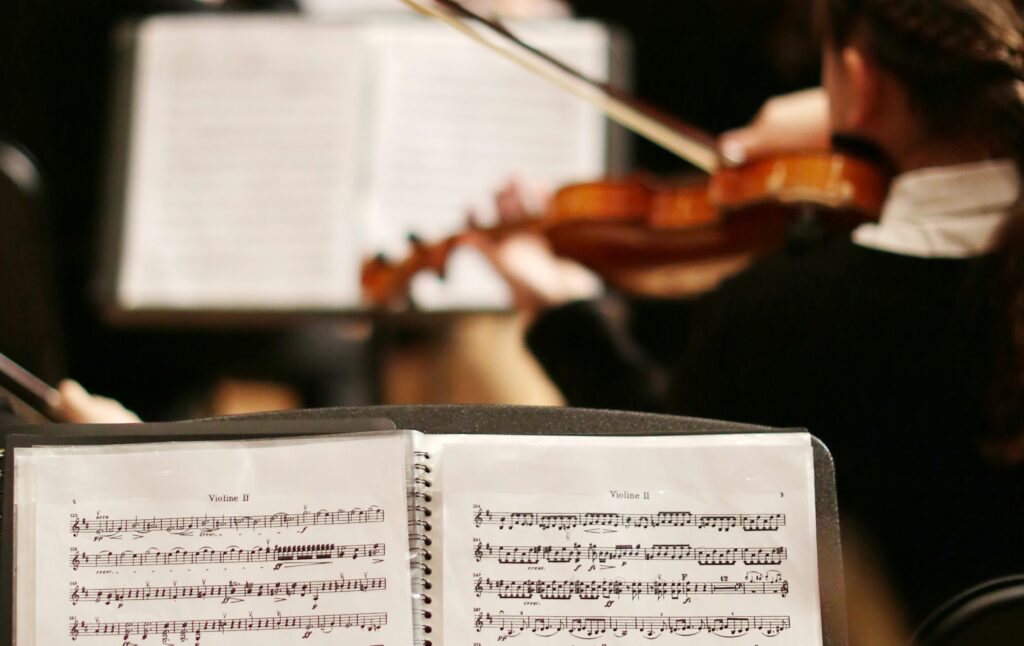
Following a difficult season of illness and isolation, I booked a ticket to a candlelit performance of Vivaldi’s The Four Seasons in one of Adelaide’s historic buildings. It felt like the kind of evening that deserved more than simply arriving.
So I made myself a dress inspired by Christian Dior’s New Look of 1947. After years of wartime austerity, Dior’s answer was an unapologetic return to beauty, romance and hope. Mine, in miniature, was doing the same.
That’s the difference between looking at something beautiful and being changed by it. One asks nothing of you. The other asks everything.
Beauty doesn’t exist only to decorate our lives. It exists to deepen our experience of them: a refugee planting flowers before there’s food to eat, a prisoner catching a sunset through barbed wire, a bowl mended in gold rather than hidden, an evening in candlelight after a season that had asked everything of you.
Sometimes attention goes first. Sometimes beauty does. You don’t have to pick a side. You only have to notice when it arrives, and let yourself be changed by it. That, I think, is the actual reward.

You May Also Like
The Currency that Can’t Be Bought